
Theoretical
 Visit Channel
educational math videos that build deeper understanding

Start Exploring
My current project is a video series exploring various aspects of functions. This started with three videos on evaluating linear expressions, solving linear equations, and graphing linear functions. While the video series quickly moves on to more advanced functions, I wanted to include these videos as an introduction to my style of instruction and some of the methods that I use in the series.
From there, I jumped into absolute value functions, which was a great opportunity to dive deeper into the graphing process. I ended up considering translations, dilations, and reflections separately, which allowed me to introduce the concept of key points in perhaps excessive detail.
Finally, I made it to quadratic functions, which is where the project currently sits. I initially planned to follow the same evaluate-solve-graph structure that I adhered to for linear and absolute value functions, but I quickly realized that there was so much more that I wanted to explore. This chapter of the series eventually grew to 16 videos, and while I'm proud of how each video turned out, I would like to highlight one video in particular here.
I looked forward to making this video for a long time because I've always been enamored with the derivation process of the quadratic formula. Too often, the quadratic formula turns into a plug-and-chug ordeal that seems to lose any sense of beauty. Thus, I tried to bring a bit of beauty to the process in whatever ways I could. Hope you can find the beauty in it as well!

Learn about Theoretical
Theoretical started coming to life in early 2022. I found myself with a few months off from work and decided that it might be fun to try making some educational YouTube videos on math topics that were of particular interest to me. So I downloaded a few free programs, found an old writing tablet that I had around, and tried my hand at generating some basic content. The results were… not great. My handwriting looked sloppy, the pacing felt off, and the end result was disappointing. But then an idea struck me — I realized that I might be able to use code to produce the visual component of the videos that I was envisioning. This would give me much greater control over my content and would hopefully yield a more visually pleasing result.
Initially, I tried using a tool called Manim for my visuals. The core of this code base was produced by Grant Sanderson for his YouTube channel 3Blue1Brown. This channel was part of my inspiration for wanting to make math videos in the first place, and I was excited to try making videos in a similar style. However, I quickly realized that Manim wasn't the right fit for me. There are several aspects of coding that I enjoy, but navigating someone else's project and figuring out how to effectively implement it is not one of them.
Thus, I decided to write my own code. I wanted the visuals to appear as if I was writing on a chalkboard, and this gave me a solid constraint to work with. I quickly learned that it would be best to base my approach on Bézier curves, and eventually I got a lightweight but working set of code that produced video exactly how I wanted it to. From there, I still had a long way to go, but the foundation was solid and allowed me to build with confidence and enthusiasm. Eventually, the project reached a fairly stable state and while I've continued making small additions and adjustments since then, the core of the code has remained the same.
After I completed most of my code, the amount of time that I was able to dedicate to this project ebbed and flowed with work and life in general. Still, I knew that I would come back to it at some point, and I finally returned to it in the summer of 2024. Once I was able to dedicate more time to this project, I realized that I wanted to make something more significant than just a couple videos on seemingly random topics. I decided to do an exploration of various functions at a secondary level and worked from there to develop an overall plan and structure. I was finally able to post my first video in October of 2024 and have continued working to post videos when I can ever since.

Meet the Instructor
My name is Theo, and I've always had a passion for math. I'm not sure exactly when that started to shine through, but I've been told that I was already doing extra math worksheets in kindergarten.
As I grew though, I didn't have many opportunities to accelerate through the standard math curriculum. Calculus wasn't an option for me to take in secondary school, and for the most part, I followed a fairly typical path through the subject. At the time, that felt somewhat limiting, but in hindsight, it gave me something that I value much more: time. Rather than rushing ahead, I had the chance to sit with ideas, review them frequently, and experiment with the ones that piqued my interest.
That perspective carried with me into college. Initially, I chose to study computer science, but over time, I felt myself drawn more and more to mathematics. Eventually I made the switch and completed my studies in that field where I found a much stronger sense of direction and motivation.
Since graduating, I've spent a number of years working in education, primarily in math-related roles. While I value those experiences, I never quite felt like I found a place where I could fully explore the kind of teaching that I was most interested in. That search eventually led me to create Theoretical — a place where I can focus on the topics that I care about most, experiment with how topics are presented, and dedicate time to making high-quality content with the potential to reach a wider audience.
Outside of math and education, I've spent time volunteering and working in the field of ecological restoration, and I enjoy several other hands-on pursuits like playing volleyball, caring for house plants, and cooking plant-based meals. Additionally, I often find myself daydreaming about ways to build a better world, and this leads to lots of mental side quests. You can learn more about one of those side quests in the next section of this website.

Explore Other Projects
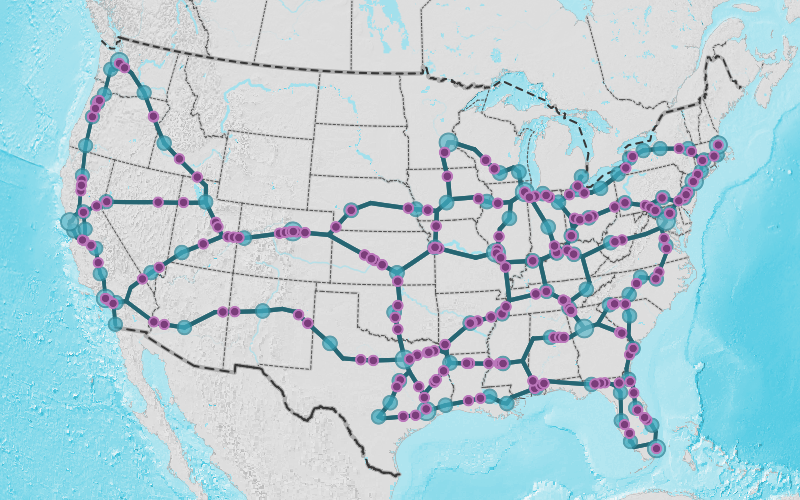
I tend to have several side projects that I'm working on at any given time. As I've learned more about coding and web development, I've been able to start bringing some of those projects to life. One of those projects is The Interconnect, a hypothetical high-speed rail simulation for the United States. This was a fairly involved project, but it was also incredibly fun, and if you'd like to explore it, you can do so at the link below.
 Visit The Interconnect

Support This Project
If you've found this project valuable, sharing it with others who may appreciate it is one of the best ways to support the project right now. Theoretical is still a small channel, and finding viewers that the content resonates with is no small task. Still, if you would like to show your appreciation for the work that I've put into this project in a more monetary manner, here's a tip jar where you can contribute.
I'm also considering setting up a Patreon page for anyone interested in that, but I'll likely wait until I'm able to produce content more consistently. Until then, any contributions to the tip jar are greatly appreciated.
 Visit Tip Jar

Get in Touch
If you'd like to get in touch, feel free to reach out at contact@theoreticalmath.net.